
Prague is a city of endless charm—stunning architecture, flowing beer, and a laid-back vibe that’s hard to beat.
But let’s cut to the chase: is weed legal in Prague? Not fully, but it’s decriminalized, and the cannabis culture is alive and thriving.
Stick around for the need-to-know details and stoner-friendly tips to make your trip both fun and worry-free.
Key Takeaways
- Weed is decriminalized in Prague, with a limit of 15 grams for personal use.
- Medical cannabis is legal but restricted to residents with a prescription.
- Buying weed is easy but comes with risks; stick to trusted sources to avoid scams.
- Public smoking is technically illegal but often tolerated in low-key settings.
Legal Status of Cannabis in Prague
Decriminalization of Personal Possession
Weed might not be fully legal in Prague, but the Czech Republic is cool with small amounts.
How Football Betting Predictions Have Changed According to Betzoid
Football betting has existed in various forms for well over a century, but the methods used to predict match outcomes have undergone a transformation so dramatic that early bettors would scarcely recognize the landscape today. What once relied almost entirely on gut feeling, local knowledge, and newspaper match reports has evolved into a sophisticated discipline blending statistical science, machine learning, and behavioral economics. Understanding how these prediction methods have changed not only illuminates the history of sports wagering but also reveals how technology and data culture have reshaped the relationship between fans, analysts, and the beautiful game itself.
The Early Era: Intuition, Form Guides, and Paper Predictions
In the early twentieth century, football betting predictions were largely informal affairs. Punters in Britain — where organized football betting first flourished — relied on match-day programs, word-of-mouth team news, and rudimentary league tables printed in newspapers. The football pools, which became enormously popular in the United Kingdom from the 1920s onward, required participants to predict drawn matches across a coupon, and success depended more on luck than analytical rigor. There were no injury databases, no expected goals models, and no tracking of player movement data.
By the 1970s and 1980s, dedicated tipsters began appearing in tabloid newspapers and specialist publications. These individuals built reputations through a combination of inside knowledge, team familiarity, and an ability to read momentum within a season. Their predictions were qualitative rather than quantitative, built on narrative reasoning: a team playing well at home, a striker returning from injury, a manager under pressure. These factors were weighed subjectively, and the tipster’s credibility rested entirely on perceived expertise and a track record that was rarely audited in any rigorous way.
The introduction of fixed-odds betting shops in Britain in 1961 formalized the market considerably. Bookmakers began employing their own odds compilers — known as traders — who assessed probabilities based on similar intuitive frameworks but with commercial incentives to price markets accurately enough to ensure profitability. Even so, the margins for error were wide, and informed bettors with superior local knowledge could find genuine value in the markets with some regularity.
The Statistical Revolution and the Rise of Data-Driven Models
The true turning point in football prediction methodology came in the 1990s and accelerated sharply into the 2000s. The digitization of football statistics, combined with the rise of the internet, made historical data accessible in ways previously unimaginable. Analysts began applying mathematical models borrowed from economics and actuarial science to football outcomes. Poisson distribution models, which treat goal-scoring as a random process occurring at a measurable average rate, became foundational tools for estimating match probabilities.
Academic research played a significant role in this shift. Papers published in journals of operational research and sports science demonstrated that certain statistical indicators — particularly goal difference, shots on target, and home advantage coefficients — held predictive power that was both measurable and consistent over large sample sizes. This gave credibility to a more scientific approach and attracted mathematically inclined analysts into the field.
The concept of expected goals, or xG, emerged from this period of innovation. Rather than simply counting goals scored, xG assigns a probability value to every shot based on its location, angle, and the circumstances of its creation. A team consistently outperforming its xG is considered fortunate; one underperforming it may be due a correction. This metric, now standard in broadcast commentary and professional club analysis, was initially developed by analysts working independently outside mainstream football institutions. Platforms dedicated to football analytics and prediction, such as https://betzoid.net/, have incorporated these evolving statistical frameworks into their prediction tools, reflecting how deeply data science has penetrated the forecasting ecosystem available to everyday bettors.
The proliferation of betting exchanges, most notably Betfair’s launch in 2000, added another dimension to prediction culture. Exchanges allowed bettors to trade positions dynamically during matches, creating an in-play market that demanded real-time analytical thinking. Prediction models had to adapt from pre-match probability assessments to live recalibration as events unfolded, incorporating goal times, red cards, and momentum shifts into continuously updated probability estimates.
Machine Learning, Artificial Intelligence, and the Modern Prediction Landscape
The most recent chapter in the evolution of football betting predictions has been written by artificial intelligence and machine learning. Where earlier statistical models were relatively transparent — built on identifiable variables and interpretable equations — modern AI systems operate through neural networks trained on vast datasets that can identify patterns invisible to human analysts. These systems process thousands of variables simultaneously: player fitness metrics derived from GPS tracking data, weather conditions, travel fatigue, historical head-to-head records, referee tendencies, crowd noise levels in specific stadiums, and even social media sentiment in the days preceding a match.
Professional betting syndicates have employed quantitative analysts and data scientists for years, applying techniques similar to those used in financial markets. The edge these groups maintain over recreational bettors has grown as their models have become more sophisticated, creating a two-tier prediction environment. On one side are institutional-grade models with access to proprietary data; on the other are public-facing tools that, while increasingly powerful, work from publicly available information.
Betzoid, which has tracked these developments closely through its analysis and prediction coverage, notes that the accessibility of quality prediction data has democratized the process considerably. Where once a serious bettor needed either personal expertise or expensive subscriptions to specialist services, today a wide range of analytical tools and well-researched prediction summaries are available to anyone willing to engage with them critically. This democratization has not eliminated the bookmaker’s edge, but it has meaningfully narrowed the information gap between professional and recreational bettors in certain markets.
Another significant development has been the integration of player tracking data from leagues that have adopted optical and sensor-based systems. The English Premier League, Bundesliga, and La Liga all generate enormous volumes of positional data per match. Analysts can now measure pressing intensity, defensive line height, and passing network centrality — factors that translate into predictive signals when processed through appropriate models. The challenge lies not in the availability of data but in the interpretive frameworks used to extract meaningful signals from statistical noise.
Behavioral factors have also received growing attention. Research in behavioral economics has demonstrated that bettors systematically overestimate the chances of high-profile teams, overreact to recent results, and undervalue statistical regression to the mean. Prediction services that account for these biases — helping users avoid the psychological traps that bookmakers have long exploited — represent a genuine advancement in the quality of guidance available to football bettors.
The Future Direction of Football Prediction Methods
Looking ahead, several trends are likely to shape how football betting predictions continue to evolve. Real-time biometric data, if it becomes more widely available and ethically permissible to use, could allow prediction models to incorporate player fatigue and physical readiness at a granular level never before possible. The integration of computer vision technology with match footage could automate the extraction of tactical patterns and spatial relationships that currently require hours of manual video analysis.
Regulatory changes across Europe and beyond are also influencing the landscape. As more jurisdictions legalize and regulate sports betting, the demand for transparent, responsible prediction tools has grown. Prediction platforms are increasingly expected to present their methodologies clearly, acknowledge uncertainty, and avoid presenting probabilistic estimates as certainties. This cultural shift toward epistemic honesty — acknowledging what models can and cannot predict — represents a maturation of the field that benefits bettors and the broader ecosystem alike.
Betzoid’s ongoing documentation of prediction methodology developments reflects a broader industry recognition that the quality of football analysis has risen substantially and continues to rise. The challenge for modern bettors is no longer finding predictions but evaluating their quality — understanding which analytical frameworks are rigorous, which are superficial, and how to weigh probabilistic information against the inherent unpredictability of sport.
Conclusion
The journey of football betting predictions from newspaper tipsters to AI-driven analytical models represents one of the most striking examples of data science transforming a traditional human activity. What began as subjective judgment shaped by local knowledge has become a discipline grounded in probability theory, behavioral science, and machine learning. The core challenge — predicting outcomes in a sport defined by its unpredictability — remains as humbling as ever. Yet the tools available to analysts and bettors today are incomparably more sophisticated than those of previous generations, and understanding that evolution is essential for anyone seeking to engage seriously with football prediction in the modern era.
Since 2010, carrying up to 15 grams of cannabis or growing up to 5 plants won’t land you in jail. Instead, it’s treated like a slap on the wrist—think of it as a weed parking ticket.
But don’t get cocky. Selling, sharing, or packing more than the limit will get you into serious trouble. Trafficking? Yeah, that’s a one-way ticket to big fines or worse, and the Czech authorities aren’t messing around with that.
Medical Cannabis is a Thing
Since 2013, the Czech Republic has been ahead of the game with medical weed.
If you’ve got chronic pain, epilepsy, or other qualifying conditions, you can get a prescription. Head to a licensed pharmacy, and you’re all set.
Unless you’re a resident, don’t expect to walk in and grab some medicinal grade for yourself—it’s strictly for locals with a prescription.
Legal Status of Hemp-derived Cannabinoids (Latest Update)
Initial Ban (effective March 6, 2024):
HHC, HHC-O, and THCP were added to the list of prohibited addictive substances after several incidents in which children were hospitalized from consuming products containing these compounds.
Expanded Ban (effective July 1, 2024):
The government later approved an amendment banning seven additional cannabinoids: THCB, HHCP, HHCH, HHCB, HHC-C8, THCH, and THC-C8.
Possible Future Ban (December 2025):
The Czech Republic is considering prohibiting e-cigarettes containing fruit flavors, cannabinoids, sweeteners, and throat-lozenge additives. If enacted, businesses will have six months to sell or dispose of current stock.
Cannabis Culture in Prague

What’s the Vibe?
Prague has a reputation for being laid-back about weed, and honestly, it’s well-earned.
Locals and tourists alike indulge, and while public consumption is technically a no-go, you’ll catch whiffs of it at parks, near the river, or outside your favorite bar. It’s like the city’s unofficial perfume.
You won’t find the same over-the-top weed shops as Amsterdam, but Prague’s chill factor more than makes up for it.
Events That Hit Just Right
Ever heard of Cannafest? It’s one of the biggest cannabis expos in Europe, and it’s held right here in Prague.
Imagine rows of booths showcasing the latest in weed tech, edibles, and merch, plus workshops and panel discussions for those looking to mix business with pleasure.
If you’re in town during Cannafest, it’s worth a visit—it’s the ultimate cannabis networking event.
Scoring Weed in Prague
Where’s the Good Stuff?
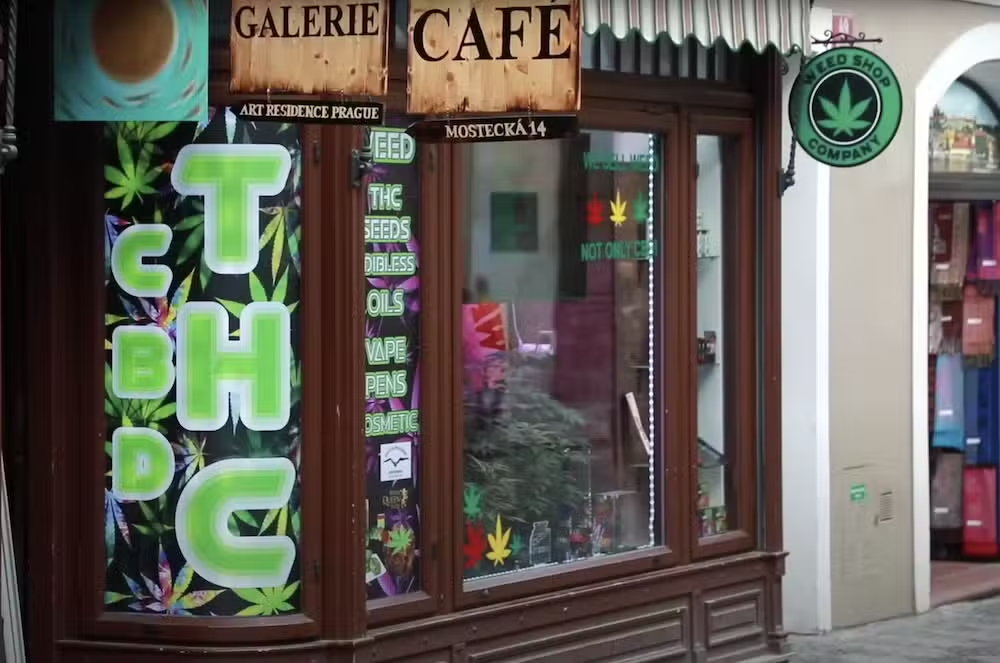
Here’s the deal: weed isn’t sold legally in Prague (yet) but that doesn’t mean you can’t find it.
Street dealers hang around tourist hotspots like Wenceslas Square or Old Town. But here’s the catch—buying from them can be sketchy.
For a safer experience, locals recommend hitting up cannabis-friendly bars or chatting with someone in the know. Word-of-mouth is your best bet for finding good-quality green without the drama.
What’s It Gonna Cost?
A gram of weed in Prague will set you back around 200-300 CZK ($9-$13 USD).
Prices vary depending on the quality, and street vendors might overcharge tourists, so be smart about it.
Watch Out for Scammers
Street dealers are a gamble. They might sell you oregano instead of actual weed—or worse, low-quality stuff that’ll ruin your buzz.
Stick with trusted connections or recommendations to avoid falling for a scam.
The Rules for Lighting Up
Can I Smoke in Public?
Officially? No. In practice? Keep it low-key, and you’re probably fine.
Parks like Letná or spots along the Vltava River are popular places to chill and spark up.
Just remember to respect the locals and clean up after yourself. No one likes a messy stoner.
Know Your Limits
Prague’s laid-back vibe doesn’t mean you should overdo it. If you’re new to weed or unsure about what you’ve bought, start slow. The last thing you want is to green out in a city where you don’t speak the language.
What Happens If You Mess Up?
Cross the Line, Pay the Fine
Carrying more than 15 grams of cannabis or growing more than 5 plants? That’s when things get real. Fines, confiscation, and possibly criminal charges are on the table.
Keep your stash small, and you’ll stay in the clear.
Don’t Even Think About Trafficking
Sharing or selling weed is a huge no-no in the Czech Republic. Even if you’re just passing a joint to a new friend, it could be considered trafficking.
Play it safe and keep it personal.
Planning Your Cannabis Adventure In Prague?
Our products keep your experience safe and unforgettable
Frequently Asked Questions
Can I bring cannabis to Prague from another country?
No, transporting cannabis across borders is illegal, even if it’s for personal use. Stick to local options.
Are there cannabis-friendly accommodations in Prague?
Yes, some Airbnb hosts and boutique hotels discreetly allow cannabis use. Check reviews or contact hosts directly.
Does Prague have cannabis lounges or social clubs?
Not yet, but informal cannabis-friendly cafes and bars exist. Full legalization might bring official lounges.
Are edibles available in Prague?
Edibles are harder to find than flower or hash, but some underground sources may offer them. Quality can vary.
Can I travel with cannabis within the Czech Republic?
Carrying decriminalized amounts is generally fine, but avoid smoking in train stations or on public transport.
Is cannabis paraphernalia legal in Prague?
Yes, bongs, pipes, and rolling papers are legal and widely available at smoke shops and markets.
Conclusion
So, is weed legal in Prague? Not quite, but with decriminalized possession and a relaxed vibe, it’s a great spot for cannabis enthusiasts.
Stick to small amounts, stay discreet, and avoid street scams for the best experience. As Prague moves closer to legalization, the future for cannabis tourism here looks bright.
Ready to elevate your experience? Check out our premium products to make your trip unforgettable!